Metrics without the arguments
For your key metrics, we agree on the meaning, calculation, source, exceptions, owner, and the decision each number should support.
For leadership, finance, sales, product, and data teamsI bring together the people who know the problem and someone who can make the call. We work with your metrics, data, or AI plans, then write down what you agreed on and who needs to do what next.
Discuss a workshopThe momentum should not end with the last slide. After the workshop, I write up the conclusions so the team can act on them.
The most useful sessions bring together people with different responsibilities, each of whom sees part of the picture.
Every option starts with your examples. Before the session, we clarify who should attend, what to bring, and which question we need to answer.
For your key metrics, we agree on the meaning, calculation, source, exceptions, owner, and the decision each number should support.
For leadership, finance, sales, product, and data teamsWe explore whether AI will have the right definitions, context, permissions, and human oversight. The output is a set of hypotheses and priorities, not a workshop passed off as a technical audit.
For leadership and owners of AI initiativesYour data team works through what agents mean for the way it builds and operates: metadata, semantics, evaluation, costs, permissions, and human decisions.
For data, analytics, and technology teams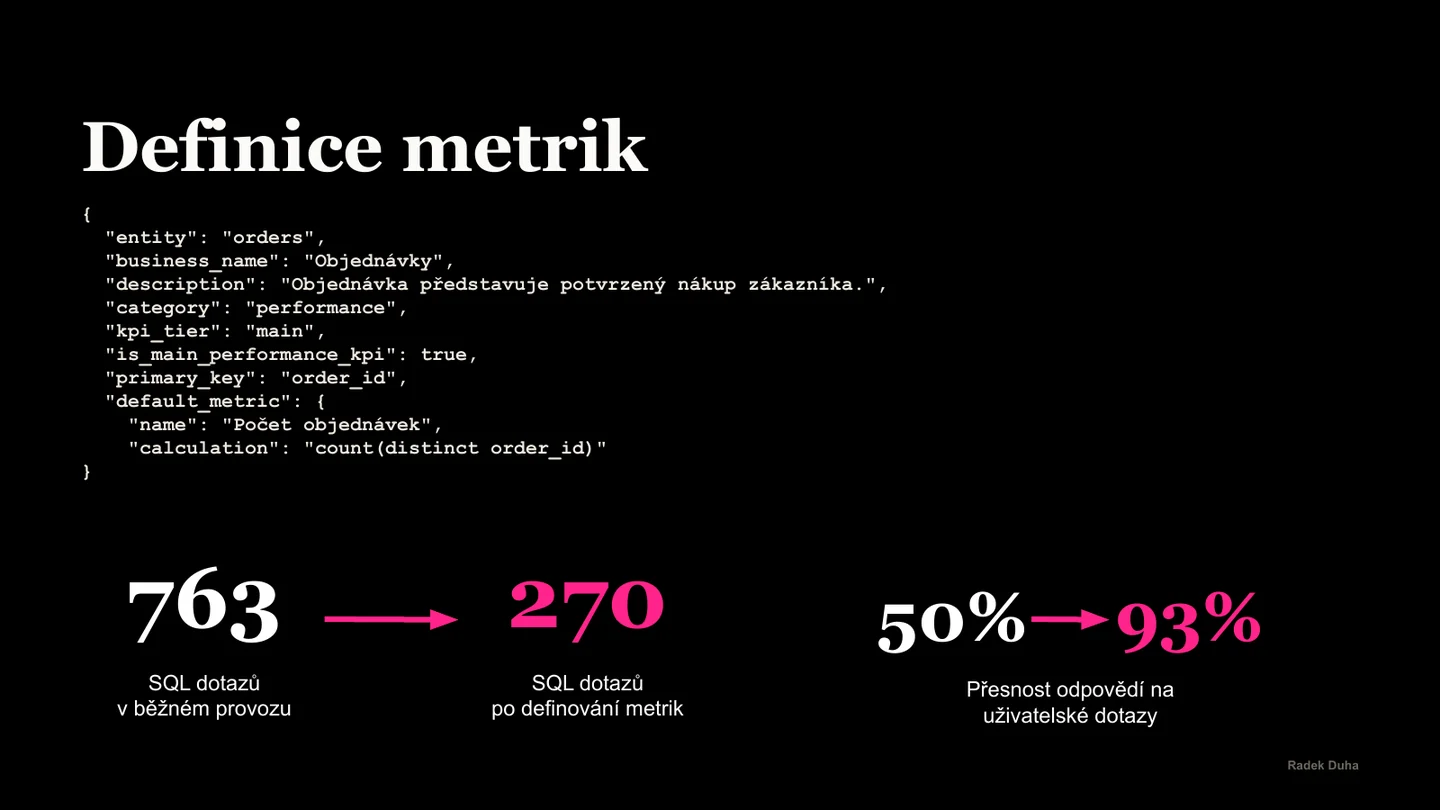
From a public talk
My work on the shift from ETL to AI agents draws on experience with data warehouses, metrics, and running data teams. The same principle guides the workshop: business meaning first, technology second.

For more than ten years, I have worked with business leaders, operational teams, and the people who build data systems. I can connect “What do we need to decide?” with the technical reality of data sources, metrics, data models, and AI.
We first clarify the problem and who needs to be involved. I then build the workshop around your examples and send the conclusions afterward.
A short conversation, a question to resolve, and the minimum materials we need.
A facilitated session focused on specific situations, decisions, and disagreements.
Agreements, open questions, responsibilities, and a recommended next step.
I adapt the format to the decision and the people in the room. These boundaries stay the same.
The goal and scope, the people involved, the materials or access needed, the deliverable, timing, price, and any follow-up work that would be a separate engagement. We start only when we have a shared understanding of all of these.
Before working with nonpublic data, we will agree in writing on which sources may be used, where they may be processed, who has access, and whether external AI tools are allowed. I do not work with nonpublic data without that agreement.
A workshop helps when leadership, business, and technical teams need to agree on a specific problem and what to do next. If participants mainly need hands-on practice with ChatGPT Work and Codex on team tasks, the training is a better fit.
The person commissioning it helps choose the question the session needs to resolve. The people in the room should know the problem, with at least one person able to decide on the next step. I will suggest the right group during preparation; a large audience with no ownership usually does not help.
I propose the duration, format, group size, and price based on the goal, preparation needed, and people who need to be in the room. We agree on these details before work begins.
Not automatically. The workshop ends with actionable conclusions and a next step. If you need an audit, a workflow sprint, or other help, we agree on that separately.
Send me a few lines about the situation and who needs to be in the room. I will suggest whether a workshop, an audit, or another first step makes sense.
Prefer writing from your own inbox? jsem@radekduha.cz